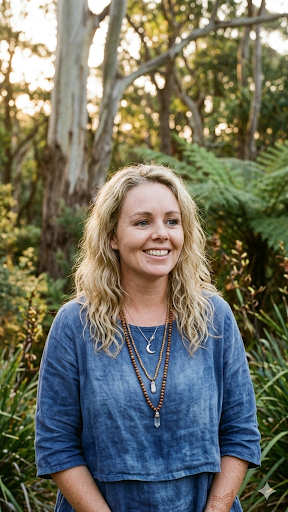
Shannon is a UK-trained Registered Mental Health Nurse and Psychedelic Practitioner. She spent two years as a clinical researcher in ketamine treatment for depression at the University of the Sunshine Coast, work that deepened her understanding of the neuroscience underpinning psychedelic-assisted therapy and sharpened her focus on what happens in the weeks after treatment ends. Her broader clinical background spans forensic psychiatry, acute inpatient care, community mental health, and ketamine-assisted therapy. She founded MindAtlas Integration and developed the Lighthouse Method — a structured 40-day integration framework built at the intersection of clinical neuroscience, trauma-informed care, and cross-cultural shamanic wisdom. Shannon works with people navigating the period after significant psychedelic experiences, whether they arrived by intention or by necessity. She is based between the UK and Australia.
Nobody needs to be fixed.
They just need to walk the path to who they are becoming.
Most people arrive here not because something is wrong with them. They arrive because they have lost clarity. Lost the thread. Lost the motivation or the hope that something different is possible. Others because they have seen the possibilities and want to make them reality.
And not everyone arrives by choice. Many people have tried other things first — years of other things — that did not quite reach where the difficulty lives. Talking therapy that helped but did not move the deeper thing. Medication that managed but did not shift it. Years of trying to think their way through something that lives below thought.
Some arrive because something beyond their control changed their path entirely — a diagnosis, a loss, a relationship, a version of themselves that no longer fits the life they are living. A trajectory that shifted to one they did not ask for and do not yet recognise.
This place is for them. Exactly for them. Not despite how they got here. Because of it.
No words will fully capture what you are feeling or how it weighs. And this may be hard to believe when you are in the middle of it — you are not failing. Sometimes we just need guidance and to be held when our sense of safety, certainty, and self has been shaken. Be it realising your purpose, rejuvenating joy in your life, letting go of pain, or proudly evolving as your authentic self.
Integration is not the process of going back to who you were. It is the process of walking the path to who you are becoming — even when the noise of ordinary life makes it hard to see.
The power doesn't come from the medicine or the framework. It comes from you — working with both, unapologetically, honestly, one movement at a time.
— ShannonAnd that is the part nobody really wants to hear. When you are already struggling to cope with the world, being told the work is yours feels like one more thing being added to a pile that is already too heavy.
So let us be honest about what this is.
MindAtlas is not here to tell you what your experience meant. It is not here to hand you a version of yourself to perform. It is not wiser than you about your own life.
What it gives you is structure. A forty-day container built on real neuroscience, at exactly the moment when the medicine has created the conditions for change. Daily practices of five to twenty minutes. A diagnostic system for when you get stuck — not so you can be told why, but so you can recognise it yourself and know the next movement. Tools for the parts of this that are cognitive, somatic, relational, and existential — because all four need attending to, not just the one that is easiest to talk about.
And it asks one thing in return. Not polish. Not performance. Not arriving with the right insights or the right language. Just honesty. Meeting yourself where you actually are — not where you think you should be by now — and making the changes you can actually meet.
Not a leap across the gap between who you were and who you want to become. Just the next true step. The one that is actually yours to take today.
You don't need someone to tell you what to do. You need someone to stay in the room while you walk your own path — without judgement, without rushing, without pretending it is easier than it is.
— ShannonThat is what MindAtlas is built to do. Not to lead you somewhere. To hold steady while you keep moving.
The framework does not ask how you got here. It starts from where you are.
The strength was never missing. Sometimes we just need the right conditions to walk toward where it is taking us.
She watched the cycle happen
again and again — and could not
leave it unaddressed.
Shannon's clinical background spans the most demanding edges of mental health practice — forensic psychiatry, acute inpatient care, community mental health, drug and alcohol services. She has spent her career sitting with people at the most extreme points of human experience, and watching a system consistently underestimate their capacity for change.
When she moved into psychedelic research and ketamine-assisted therapy, she recognised a pattern she could not leave unaddressed: the most significant, life-altering experiences people had ever had were receiving almost no structured support for the ordinary days that followed.
People focused so intensely on the session itself that when transformation did not arrive all at once, some of them became more unwell than before. The all-or-nothing thinking the experience had briefly lifted would return — now carrying the additional weight of having glimpsed what was possible and believing themselves unable to reach it.
What they concluded was almost always the same: that they had failed. That the medicine did not work for them. That they were the one person for whom transformation was simply not available.
The experience was real. The authentic self they glimpsed was genuinely there. What failed them was not the medicine and not themselves. What failed them was the absence of a structure for what came after.
— ShannonShannon founded Mind Atlas Integration to close that gap. The Lighthouse Method is her original clinical contribution to the field — built not just from theory, but from twelve years of clinical practice and a decade of personal becoming.
Not the only way.
One tested way.
MindAtlas does not claim to be the only integration framework. It is one evidence-based framework among others. What makes it distinct is its structure — built at the intersection of clinical neuroscience, trauma-informed psychology, and shamanic wisdom traditions.
The 40-day container is not a wellness concept. It is the neuroplastic window — the period when BDNF is elevated and the default mode network is still disrupted. The Four Territories are not metaphors. They are the four dimensions of human experience that psychedelic sessions touch simultaneously.
MindAtlas offers structure, diagnostic tools, and daily practice. What it does not offer is certainty. There is no promise that insight will become change. There is no claim that forty days is all that is required. The method creates conditions for integration. The integration itself is yours.
Integration is not something that happens to you. It is something you participate in — daily, deliberately, over time.
— The Lighthouse MethodThis is built for people who are ready to do the work. Not people who want to be told it will be easy. If you are here, you already know the truth: transformation requires participation. MindAtlas holds the map. The navigation is entirely yours.
A framework built at the
intersection of three traditions
that rarely meet.
Clinical Neuroscience
Research from Imperial College London and Johns Hopkins on BDNF, neuroplasticity, and the default mode network forms one load-bearing pillar of every practice in the framework. The 40-day container is not a wellness concept — it is the neurobiological window for building new neural architecture.
Trauma-Informed Psychology
Motivational Interviewing, ACT, Polyvagal Theory, somatic work, and grief processing are woven through the entire method at the structural level — not mentioned as caveats. Safety and nervous system literacy are the foundation, not the footnote.
Shamanic Wisdom Traditions
The Shipibo, Mazatec, Lakota, Andean, Siberian, and Aboriginal traditions arrived at the same understanding through entirely different paths. Where they converge with modern neuroscience is precisely where the Lighthouse Method lives. Neither is decoration for the other. Both are load-bearing.
The Diagnostic Layer
Most integration approaches offer practices. MindAtlas offers practices and a diagnostic system — the Five Integration Gaps — that identifies precisely why insight is not becoming change, and matches the evidence-based intervention to the specific gap that is operating.
This wisdom did not
begin with us.
MindAtlas acknowledges the Traditional Custodians of Country throughout Australia and their continuing connection to land, sea, and community. We pay our respects to Elders past and present.
We also acknowledge the indigenous peoples of all nations whose sacred plant medicine traditions form the foundation of the healing knowledge this platform is built upon — the Shipibo, the Mazatec, the Lakota, the Siberian shamanic traditions, and countless other peoples who have held and developed this knowledge for millennia. You are the original holders of this understanding.
The four-territory structure at the heart of the Lighthouse Method resonates with indigenous healing frameworks held across every continent — including Te Whare Tapa Whā, the Māori model of health developed by Sir Mason Durie, and the Medicine Wheel traditions of First Nations peoples across the Americas. We honour these traditions as prior holders of this understanding. The application to psychedelic integration is Shannon Simons' original clinical contribution — but the underlying wisdom belongs to those who came before.
We are committed to cultural humility, ongoing learning, and reciprocity.
— MindAtlas IntegrationMindAtlas began to exist
somewhere over the ocean.
Shannon had returned to the UK for the first time in six years — back to her origins, the family, the relational world that predated all of it. On the flight back to Australia, back to her actual life, there were emotions she was not yet ready to sit with. And so she did what she knows how to do when looking inward feels harder than looking outward: she focused on others. She opened her laptop. She started building something she could give away.
Bit by bit, over hours at altitude, the Lighthouse Method took shape. She was doing exactly what she watches people do after profound experiences: staying cognitive, staying useful, staying anywhere but in the feeling.
If you have found this book, you are probably doing the same thing. Reading at 11pm. Staying in the analysis. Understanding everything and feeling like nothing has changed. I recognise you — not because I diagnosed you, but because I am you.
Integration is not one practice.
It is four dimensions of a single living process.
Psychedelic experiences touch all four simultaneously. Integration that only addresses one or two dimensions tends to stall — which is why the framework works across all four simultaneously.
Mind
Making sense of what you saw. Working with how you think, story-tell, and make meaning — including the default mode network patterns that the experience disrupted.
Body
Landing the experience in your cells. Integration that stays purely cognitive leaves the medicine stranded in the body as unprocessed energy. The nervous system is the primary integration substrate.
Spirit
Living what you came to understand. Working with meaning, purpose, grief, ritual, and the dimension of experience that transcends ordinary psychological categories.
Community
Bringing your changed self back into relationship. The most underserved territory in the field. We are not wired to heal alone. Witnessed change consolidates differently than private change.
MindAtlas will not tell you who to become or what your experience meant. It will give you a structure rigorous enough to hold you while you walk the path to who you are becoming — honestly, at your pace, one movement at a time.
The first week is free. There is no correct starting point. There is no falling behind.
The lighthouse holds steady. The navigation is yours.
One movement at a time.